Monday, March 22, 2010

Young adult health insurance extension

To complete the information in my last post, here's the language from the Senate health insurance bill.  If you do choose to open it for yourself, be careful to download it first.  Else your browser will crash like mine did.  Read the section below, and tell me, what do they mean by "adult child"? 

‘‘SEC. 2714. EXTENSION OF DEPENDENT COVERAGE.
‘‘(a) IN GENERAL.—A group health plan and a health insurance issuer offering group or individual health insurance coverage that provides dependent coverage of children shall continue to make such coverage available for an adult child (who is not married) until the child turns 26 years of age. Nothing in this section shall require a health plan or a health insurance issuer described in the preceding sentence to make coverage available for a child of a child receiving dependent coverage.
 ‘‘(b) REGULATIONS.—The Secretary shall promulgate regulations to define the dependents to which coverage shall be made available under subsection (a).
‘‘(c) RULE OF CONSTRUCTION.—Nothing in this section shall be construed to modify the definition of ‘dependent’ as used in the Internal Revenue Code of 1986 with respect to the tax treatment of the cost of coverage.

I'm suddenly realizing that, unlike Spanish, English does not have a common, gender-neutral word for offspring that doesn't carry a connotation of age.  It must be either son, daughter, or child.  And "child" does not sound compatible with "adult".  Does the language "adult child (who is not married)" (1) restrict the meaning of "adult child" to unmarried offspring between 19 and 26, or does it merely (2) exclude married adult children from the scope of the law? 

In either case we have open before us a field ripe for debate about the meaning of adulthood.  Start with Genesis 2.  Verse 24 may apply to the definition of adulthood.

"For this reason a man will leave his father and mother and be united to his wife, and they will become one flesh."

Verse 25 may apply to the attitude of certain lawmakers.

"The man and his wife were both naked, and they felt no shame."

Sunday, March 21, 2010

Health insurance as social policy

CBC News - Health - Historic U.S. health-care bill passes

The bill would require most Americans to carry insurance, with subsidies for those who can't afford it. It would also create state-based exchanges where the uninsured can compare and shop for plans.
Seniors who spend more on prescription drugs would get a more generous benefit, including a $250 rebate this year. Young adults could remain on a parent's insurance plan until age 26, and no one with a pre-existing health condition could be denied insurance coverage.

What impact will this have in future decades? I predict young adults will take longer to emancipate themselves because they want to stay under their parents' insurance plan. I haven't yet found the provision within the bill, which would provide more complicated details. The following 2008 brief by the Urban Institute will give some numbers on young adult health insurance (one in three don't have it, including me, and most of them don't think they need it), and alternatives to the plan hurtling its way through Congress.

Comically, even the President has doubts about whether young adults are paying attention to this issue.

Sharmina Manandhar, "Young Adults to Get Parents' Health Coverage Under House Dem Plan." Southern Maryland Online (Oct. 12, 2009)

The provision for young adults was also one of the points outlined by President Obama in his health care reform rally in Maryland last month.

"Because under this plan -- listen up, young people -- under my plan, if your parents have health insurance and you're currently on their policy," Obama said in University of Maryland, College Park. "You will automatically be able to keep your coverage until you're 26 years old."

Boethius on wikked lordz

As I told you before, my senior project is to analyze the vocabulary used by Geoffrey Chaucer and Elizabeth I in their translations of Boethius' work The Consolation of Philosophy.  I'm currently editing the text file for the fourth of five books in Elizabeth's translation, and came upon this gem.  Book 4, Meter 2 set me thinking about President O'bama. All the pressure on him and in him to pass a health insurance reform act... or not to pass it, while he in himself is powerless to actually do the voting in Congress.  He's been painted as a blackguard (no pun intended), so listen to what Boethius says about an actual tyrant.

Thos wiche you se as Kings.
Sit in the top of hiest Seat
Florishing wt purple fayre
Invyrond wt dreadful armes
5 With ireful looke that thretes
for hartz yre scant drawing brethe
If any take from wicked men
Of false honor the cover
Within shal se ther Lordz
10 Straightnid gives to beare
hither Lust them drawes
here ire ther myndz afflictz
Who sturred raiseth stormes
Sorow or the taken wers
15 Or Slippar hopes tourment
Wherfor whan One hed
So many tirantz beares
he doth not that he wold
prest wt so wicked Lordz

 Hard to follow? That was Elizabeth I.  Try Chaucer instead:
Bo4 m2 1 "Whoso that the coverturis of hir veyn apparailes
Bo4 m2 2 myghte strepen of thise proude kynges,
Bo4 m2 3 that thow seest sitten an hye in here chayeres,
Bo4 m2 4 gliterynge in schynynge purpre, envyrowned
Bo4 m2 5 with sorwful armures, manasyng with cruel
Bo4 m2 6 mowth, blowynge by woodnesse of herte, he
Bo4 m2 7 schulde seen thanne that thilke lordis berin
Bo4 m2 8 withynne hir corages ful streyte cheynes. For
Bo4 m2 9 lecherye tormenteth hem on that o side
Bo4 m2 10 with gredy venymes; and trowblable ire,
Bo4 m2 11 that areyseth in hem the floodes of trowblynges,
Bo4 m2 12 tormenteth upon that othir side hir
Bo4 m2 13 thought; or sorwe halt hem wery and icawght,
Bo4 m2 14 or slidynge and desceyvynge hope turmenteth
Bo4 m2 15 hem. And therfore, syn thow seest on heved
Bo4 m2 16 (that is to seyn, o tiraunt) beren so manye
Bo4 m2 17 tyranyes, than ne doth thilke tyraunt nat that he
Bo4 m2 18 desireth, syn he is cast doun with so manye
Bo4 m2 19 wikkide lordes (that is to seyn, with so
Bo4 m2 20 manye vices that han so wikkidly lordschipes
Bo4 m2 21 over hym).

For a Biblical parallel, go to Psalm 73.
1 Surely God is good to Israel,
to those who are pure in heart.
2 But as for me, my feet had almost slipped;
I had nearly lost my foothold.
3 For I envied the arrogant
when I saw the prosperity of the wicked.
4 They have no struggles;
their bodies are healthy and strong.
5 They are free from the burdens common to man;
they are not plagued by human ills.
6 Therefore pride is their necklace;
they clothe themselves with violence.
7 From their callous hearts comes iniquity;
the evil conceits of their minds know no limits.
8 They scoff, and speak with malice;
in their arrogance they threaten oppression.
9 Their mouths lay claim to heaven,
and their tongues take possession of the earth.
10 Therefore their people turn to them
and drink up waters in abundance.
11 They say, "How can God know?
Does the Most High have knowledge?"
12 This is what the wicked are like—
always carefree, they increase in wealth.

* * *

16 When I tried to understand all this,
it was oppressive to me
17 till I entered the sanctuary of God;
then I understood their final destiny.
18 Surely you place them on slippery ground;
you cast them down to ruin.

19 How suddenly are they destroyed,
completely swept away by terrors!

20 As a dream when one awakes,
so when you arise, O Lord,
you will despise them as fantasies.

For a Biblical contrast, go to Jeremiah 17:7-8.

But blessed is the man who trusts in the LORD, whose confidence is in him. He will be like a
tree planted by the water that sends out its roots by the stream. It does not fear when heat comes; its leaves are always green. It has no worries in a year of drought and never fails to bear fruit.

I just now heard that the health insurance bill was passed a few minutes ago.  These words still apply:


Wherefore when One head / so many tyrants bears / he doth not what he would / pressed with so wicked Lords.

Monday, March 15, 2010

Review of Josh Harris: Courship Smourtship

I'm not a fan of attack blogs. They're fascinating, in a deadly sort of way. They bend me in a negative direction that I naturally follow already. But the following post by Steve reviews a 2005 sermon by Josh Harris of Covenant Life Church in Maryland, over the fallout of his early courtship principles in stunting healthy male-female relationships among young adults at the church he attends.

Here are some points that Joshua Harris made in a message entitled “Coursthip Smourtship: What Really Matters in Relationships” given on November 20, 2005. In this message he acknowledged that how some of single men and women in his church related:
  • Could be described as standoffis, overly reserved, a certain level of uptightness
  • Isn’t how relationships should work in God’s family
After acknowledging these problems Harris indicated what he thought was proper for singles:
  • Felt desire for God to bless single men and women with the good gift of marriage in his time.
  • Didn’t want the singles ministry to become a “meat market” but one in which godly friendships can lead to purposeful courtships and God glorifying relationships
  • Purposeful courtship can only happen when if mature men and women first feel the freedom to get to know each other in brother/sister friendships
  • Men not scared about initiating friendships with women
  • Felt there had been some confusion
  • It is ok for brothers and sisters to go out to lunch/dinner together, grab coffee, and email one another.
  • Should ok talk church lobby w/o asked when is the wedding date
Harris also clarified his views on singles “guarding one’s heart.” Harris even felt the word was misapplied:
  • One should not become self focused in attempt from ever being disappointed.
  • Not to guard your hearts from attraction (don’t run away from a friendship when there is attraction) God can help process that it in godly way;
  • If attempt guard ourselves against attraction/disappointment will cut ourselves off from the good gifts of friendship/fellowship that God has for us.
  • If not mutual attraction/interest God help you walk through that. There will be times of disappointment.
  • Some walk out courtships decide not to get married; successful if walked out in integrity;
I admire that Harris did have the courage to acknowledge problems at his church. Usually one is well on to solving a problem after the problem has been acknowledged. Hopefully this message at least brought about changs at CLC with how the singles relate. The message was given 2.5 years ago. For those of you reading this still part of a SG Church what change have you noticed at CLC or within SG as a result of this message?

It is interesting to note that even at Harris’s own church there were significant problems with how singles related. From reading his books and looking at his website you would think that only dating had problems. Harris doesn’t mention any problems with his system in his books. People say that there is never a “perfect church” but when I read his books one would think he has found perfect system for singles.

Here's Josh's own brief "update", with links to the following messages:

These messages all reflect, in one way or another, things that I’ve learned since I wrote the book I Kissed Dating Goodbye 12 years ago. I still stand by the message of the book that premature, short-term romantic attachments can be a big distraction from serving God—especially for teenagers. But in the years since, I’ve also seen that a legalistic application of these ideas can be unhelpful, too. One of my main concerns in our church or any other church is that there be no disunity among Christians over issues of dating and courtship. We need to learn to hold our own convictions on this matter with charity. Most importantly, we need to make sure that our convictions are shaped by Scripture—not culture, church culture or my books.

The following are messages I preached here at Covenant Life out of a desire to clarify what I see as a wrong application of ideas I’ve written about. If you’ve attended Covenant Life for a few years, you’ve likely heard one or more of these, but I hope they’re helpful.

“Romance Revisited” is a message I did last summer at our church’s annual youth retreat. My main burden was to challenge teens to cultivate their own biblical convictions on the topic of dating and relationships, and to make the distinction between commands from God’s word and the wise application of biblical principles.

“Courtship Shmourtship” addresses some misconceptions people can have about courtship, and examines biblical principles that should inform our relationships. I speak to singles who are so concerned with “guarding each others heart” that they’re not talking to one another.

“Courtship is a Community Project” looks at how godly relationships can function in the context of the local church. It’s a challenge to the whole church to come alongside single men and women and provide support and encouragement as they pursue relationships.

Maybe someday Josh will find time to write another bestselling book to rectify his first one.  Not Even a Hint is the only one of Josh's books that I have read entirely, so any contribution of his ideas to my relational difficulties is diffuse at best. :)  From the outline, though, his re-assessment is spot-on.  It's almost as if friendship can no longer be casual, and starvation of natural relationships conspires to feed unnatural fetishes and fantasies.  Self-focus is a deadly denominator.  Thus, the inverse should exclude the middle value of self-focus for a regression on the sides of both less-intimate and more-intimate friendships, giving us the original excluded middle of healthy friendship between the original restrictions of no-contact and marital commitment. 


I should give it a listen after finals week is over.  In the meantime, I should get back to math review, where this kind of symbolic language actually makes sense.

Back into the

.
From this


To this


Saturday, March 13, 2010

Film: Los últimos de Filipinas

Los últimos de Filipinas, "The last of the Filipinos", is a Spanish film made in 1945 about a garrison of 50 Spanish soldiers in Baler, the Philippines, who withstood a siege by American and Rebel forces for 11 months during the Spanish-American War. Although the war officially ended in December 1898, these men kept fighting until summer of 1899 because they were cut off from communications. It's interesting to watch, because their part in the war is just as valid as our part.

Wednesday, March 10, 2010

"How few words can the shortest story have?"

An essayist ponders Ernest Hemingway's short story of six words: "For sale: baby shoes, never worn."


Amihud Gilead, "How few words can the shortest story have?" Philosophy and Literature, 32.1 (April 2008)

How to do the maximum with the minimal number of words, or how to do the best with the minimal or few words, is a key question.  Hemingway's story focuses around a tragedy of a  great loss, perhaps the greatest possible, the loss of the greatest hope or expectation.  By limiting itself to this tragedy, these six words open a wide human world for the readers.
             * * *
The grief and mourning appear to confine or restrict the world but, in fact, they open it wider.  A whole world has been changed because of the loss of one child...
             * * *
Hemingway's story could not be a poem.  It is as if a notice or an advertisement appeared in a newspaper... Nevertheless, Hemingway's six words do not make an advertisement. To do so, some indispensable details are needed, such as the address or the means of communication by which the seller can be reached as well as something about the price of the item.  The lack of such details makes these six words commercially useless or impractical yet leaves their artistic value intact.  Were these details mentioned, the reader would think that the six words were still artistically put although for a commercial aim.
              * * *
The tension between the practical aspect of an advertisement and its artistic significance opens an unbridgeable gap.  It is the gap between mundane life and a great artistic achievement.  This gap is a loss.  It embodies the very loss, the unbridgeable gap between grief or misery and real beauty; between real beauty and the mundane world of commerce, advertisements, and innumerable pretty things.  The baby is dead; the shoes are for sale; what remains is Hemingway's best story.  What remains is the beauty of genuine art.
              * * *
Science fiction, pulp fiction, and the like need only one's imagination and intellect; that is all.  They offer us a game: a puzzle to be solved, something to entertain the reader and not much more.  Hemingway's shortest story does not entertain us.  It demands much more. It demands the reader's commitment and it does so from the reader as a whole person, not only as an imaginative person or one capable of solving or dissolving puzzles.  Without deep emotions, the reader could not get the point in Hemingway's story.
              * * *
Hence, the best shortest story may contain some thousands of words or more, provided that not even one single word in it is superfluous; rather, each word is indispensable for creating or revealing a whole world.  Moreover, the story lacks nothing.  As long as such is the case, it does not matter how many words the story contains.  Everything that the reader needs is there, waiting for him or her to uncover it.
              * * *
How many superfluous or missing words may the best shortest story have?  My answer is: Not one.  Each word in such a story is entirely necessary or indispensable; not one is missing.  Six words may be good enough to create or to reveal a whole world of beauty, a cosmos.

Tuesday, March 09, 2010

Umbrella in the antumbra

As a nor'wester, I can't think of a better use for a red umbrella.

Acercarse al campo de batalla

Me acerco al campo de batalla a hurtadillas, tan silencioso como un indio, y ningún de los combatientes me oyen al golpeando del valor en mí corazón.  Lo sólo que se puede oír sobre el ruido de pelea es el estruendo de mi tanque.  «¿Dónde está la Justicia?» – dicen los heridos – «¿Por qué no acudiría para defendernos?»  Pero hoy no he acudido para quedarme, sino para llevar otro pasajero conmigo.

I approach the field of battle stealthily, as silent as an Indian, and not one of the warriors hears even the thumping of the courage in my heart.  All that can be heard over the noise of fighting is the roar of my tank.  "Where is Justice?" - say the wounded - "Why doesn't she come to defend us?"  But today I have not come near to stay, but only to take another passenger.

Friday, March 05, 2010

Blue Letter Bible: Sayings not found in Scripture

I lead a discussion group of apologetics students on Wednesday nights, talking through responses to questions and statements such as "If God is invisible, how can Man be made in his image?" or "Every charitable act is a stepping stone to heaven."  So I was joyed tonight to find this faq list of sayings not found in Scripture.  It is on the website of Blue Letter Bible, which mainly offers the Bible online with links to commentary, but because readers keep emailing them asking where to find [x] saying in the Bible, they created this faq.

I have reprinted below their analysis and response to the phrase "once saved, always saved".


First of all, slogans like "Once Saved, Always Saved" are always regrettable because they polarize an issue, causing them to be touted or denounced vehemently not on the basis of truth as truth is, but only as it is represented in the stark world of sloganeering.

Take for instance, the present slogan—Once Saved, Always Saved. This is based upon the doctrine of the perseverance of the saints, but skews the doctrine by only representing a portion of its teaching. In fact, the slogan doesn't give us enough information to properly judge its merits. As well, the slogan is tautological in its simplicity, so that in being inherently true on its face, it is unable to say anything of value. One might as well say, "Once one has eternal life, he shall always have eternal life." This is obvious by the very definition of eternal life; and so, the slogan teaches us nothing of value. It is likely that this slogan (like most slogans) was created for a very particular purpose, but has long since (again, like most slogans) outgrown that purpose.

Instead, let's look at the doctrine to which the slogan makes reference.

When we speak of the perseverance of the saints, we are, in the first place, speaking not of any power within the grasp or intention of men who believe but rather of the strength of God's own redemptive and recreative work. Because men are saved by grace and not works, the sinful works of men are no great obstacle if God wishes to recreate a man into the image of his Son. The effect of Christ's blood in redemption is complete. So powerful is the blood of Christ that all sins of those that God ordains it to cover are washed in their entirety. As well, when God deems to recreate a man in the image of Christ, he begins the creative work and is faithful to complete it in his time despite the work's potential inclinations to the opposite.

When we speak of perseverance, we are really speaking of God's faithfulness rather than man's. As well, we are not speaking of any statement or decision a man could make. Part of the flaw in the slogan's respect is the preponderance of the contemporary understanding of being "saved." While salvation is a very biblical notion and Scripture does point out that man must be saved, believers too often view this as an effect of a profession of faith rather than the result of God's work of grace. The distinction is palpable. Obviously, anyone can make a profession of faith and live for a time with external evidence of the work of redemption in their lives and yet still be without the work of grace. Though, we might refer to them in our ignorance as the saved, they are anything but. Their profession and life are counterfeits of the life of the honestly saved. The doctrine of the perseverance of the saints declares that those who are of this kind were never recipients of the persevering work of God's grace, were not sealed by the Holy Spirit, and did not receive at anytime the cleansing, redemptive, and recreative work of Christ.

The doctrine of the perseverance of the saints maintains that those who overcome the world—those who abide in Christ—until they die and are taken up to heaven are the saved. They are the ones who persevere. Any who do not persevere simply were not saved for they did not experience the saving grace of God, were not conformed to the image of Christ, and were not forgiven of their sins. Therefore, it stands to reason that they as well never possessed eternal life—for eternal life is eternal.

The plain fact is that Scripture encourages believers to work in righteousness as they reflect the glory of their Lord. And Scripture offers security for those who have this work of grace alive in them. Those who claim belief but do not live righteously are persuaded to fear for their place and are invited to pursue God with all their hearts, minds, and souls that they might rest in the security of God's grace.

In light of 1 John 1:9's admonition to confess sin for faithful and just forgiveness, the question is often asked whether a true believer, unconfessed, might not be in danger of perdition. Yet, while confession of sin before God is integral to the obedient Christian life and no true Christian will go for too long in aggressive rebellion against the confession of sin, believers are always going some duration without confessing their sin. Even if it is only the time period between the sin and one's immediate regret for and confession of that sin, there is still a period of unconfessed sin. We do not believe that this unconfessed sin can keep the true child of God from receiving that which God has claimed is his inheritance and has sealed in him with the Holy Spirit. We do believe that unconfessed sin will forge a breach in one's earthly experience of the joys of heavenly life, but not that unconfessed sin can mar the surpassing grace of God. If this were so then every believer would be in danger of perdition at the time of his death for even as Christians, we recognize that we sin constantly in thought and deed.

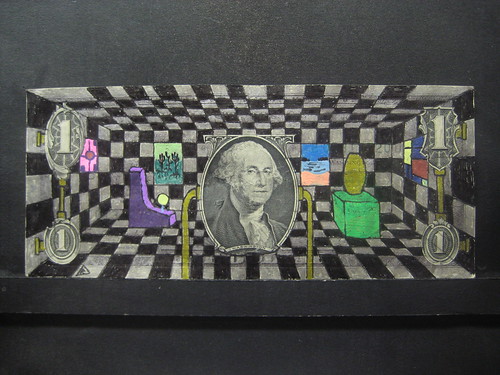
Art museum dollar


A dollar bill can be high art.

Monday, March 01, 2010

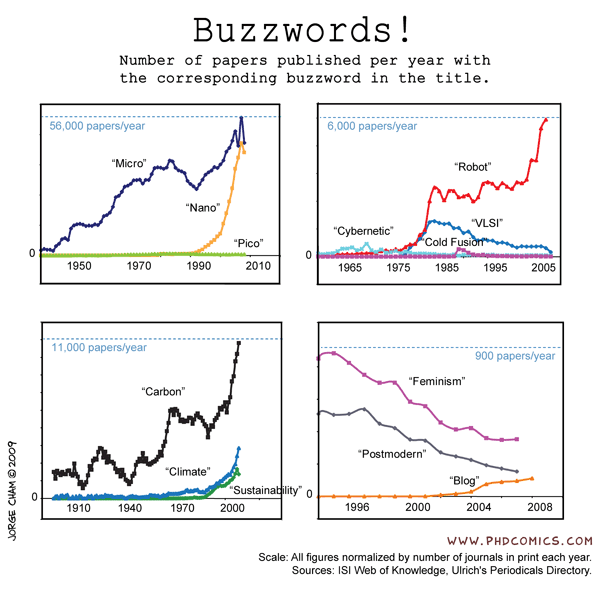
Academic buzzwords


From the Piled Higher and Deeper comic strip.

Sunday, February 28, 2010

Hugh Latimer: a man of words and not less deeds

From time to time, I like to dip into C.S. Lewis's book English Literature in the Sixteenth Century (Oxford History of English Literature).  Here's what he says about Hugh Latimer, the greatest of the popular sort of preacher during the English Reformation.  Hugh was an English priest who converted to protestantism in 1525, was made Bishop of Worcester in 1535, and burnt at the stake in 1555.

"...there is one man of real genius still to be considered.  Hugh Latimer's character may be ambiguous or even repellent: his sermons, in their own kind, are resounding successes, 'though, to be sure, not very theological'. Latimer assents, indeed, to the doctrine of justification by faith, but he is no theologian; some of his apparent tergiversations may perhaps result from the bewilderment (even the impatience) of a 'plain man' entangled in matters above his capacity.
 
Whatever he may say (when he remembers) about faith, he is really so exclusively interested in works that not only a Papist but a Pelagian or even a good pagan could read nine-tenths of his sermons without a qualm. Nor is he a humanist: ego non calleo Graece, he professed in his final examination. He is one of the purest examples in English of the 'popular' preacher in the fullest -- if you will, the lowest -- sense of that word. He boasts himself the son of an English yeoman and works in 'the uprightly, plain Dunstable way'.  He is full of anecdotes, jibes, digression, and simple vituperation; he takes his hearers into his confidence, explains how this or that illustration came into his head, forgets himself and recalls himself: all sounds as if it were extemporaneous.

We should probably be naive if we took the style at its face value. An appearance of casualness ('I am no orator as Brutus is') is one of the rhetorician's weapons: and I suspect that everything which seems to fall by chance from Latimer's lips is consciously devised to hold the attention and undermine the resistance of the audience. He establishes intimacy with them in order to sway them. It is a well understood homiletic technique which descends to him from the Middle Ages (his method has affinities with that of Chaucer's Pardoner) and which has survived into our own days under the opprobrious names of 'straight talkism' or 'high pressure Christianity'.
Some cannot endure it. They have a right to their taste, but they must not infer from the style that Latimer is a charlatan. The spiritual cheapjack and the sincere preacher both have equal, though different, motives for wishing to arrest and control a congregation and therefore may both (if they can) adopt a manner which will certainly achieve this end. 'Young feller', said General Booth to Kipling, 'if I thought I could win one more soul to the Lord by playing the tambourine with my toes, I'd -- I'd learn how.' The only test which Latimer would admit as relevant for his sermons is their practical efficacy. And they were efficacious.

 We are told that when he preached on the duty of restitution it was not long before certain anonymous donations began to reach the king's treasury. That does not perhaps justify us in calling his work literature: but the mere strength and pith and urgency of his sentences, in that age so given to verbiage, is a literary virtue. He is as importunate as Hazlitt. He would have been a fine broadcaster."    (p. 192-194)
  Now try reading his sermon on the Armor of God.  I have to say, I love his informal style, it runs better than much 16th century writing, as I know that's the way he preached.

Thursday, February 18, 2010

Jonathan Miles on the Burned-over District

Over at Midwest Christian Outreach, there's a great conclusion to a three-part series of articles on the political and philosophical origins of the culture-driven church.  Here, he talks about revivalism and the social gospel in upstate New York.  There's a range of balance that is hard to achieve in social activism... just ask Denny Hartford at Vital Signs Ministries.  It's no wonder the district in NY was called "burned-over" after all the revivals and temperance meetings.


Jonathan Miles, Revivalism in the Burned-over District part 3.

Monday, February 15, 2010

Rowan Williams on the basis for Christian ethics

Tonight at Gleaners I picked up a book by John Shelby Spong, former Anglican Bishop on New Jersey. The book was called Rescuing the Bible from Fundamentalism. Now, reading his bio on Wikipedia, I found a link to a response by Rowan Williams, who in 1998 when the article was written was Bishop of Monmouth, and now is Archbishop of Canterbury. Williams was responding to Spong's "12 theses" or statements of how the basic truths of Christianity must change or die. I always hated Rowan Williams because he ordained Gene Robinson a bishop even though he practices homosexuality. But hear him out here. Some real pastoral advice to Spong's radical unbelief.

Rowan Williams, "No Life Here - No Joy, Terror or Tears." Church Times (The Tasmanian Anglican) July 17, 1998.

Of course, if you want to misunderstand Darwin as establishing a narrative of steady spiritual or intellectual evolution, you will indeed want to say that all existing ethical standards are relative. How, then, are you going to deal with claims by this or that group that they are moving on to the next evolutionary stage? In what sense can ethics fail to be about the contests of power, if there is nothing to which we are all answerable at all times?

Of course the parameters of ethical understanding shift: but the shifts in Christian ethics on, for example, slavery, usury and contraception, have had to argue long and hard to establish that they are in some way drawing out an entailment of what is there, or honouring some fundamental principle in what is there. In other words, these changes in convention have had to show a responsibility to certain principles that continue to identify this kind of talk as still recognisably Christian talk.

It makes for hard work - as is obvious with current debates about homosexuality or nuclear war; but it is hard work because of the need to continue listening to what is said and written.

But then we discover in Spong's theses that there is, after all, a non-negotiable principle, based upon the image of God in human beings. Admirable; but what does it mean in Spong's theological world? What is the image of a 'non-theistic' God? And where, for goodness' sake, does he derive this belief about humans? It is neither scientific nor obvious.

It is, in fact, what we used to call a dogma of revealed religion. It is a painful example of the sheerly sentimental use of phraseology whose rationale depends upon a theology that is being overtly rejected. What can it be more than a rather unfairly freighted and emotive substitute for some kind of bland egalitarianism - bland because ungrounded and therefore desperately vulnerable to corruption, or defeat at the hands of a more robust ideology? It is impossible to think too often of the collapse of liberalism in 1930s Germany.

It is no great pleasure to write so negatively about a colleague from whom I, like many others, have learned. But I cannot in any way see Bishop Spong's theses as representing a defensible or even an interesting Christian future. And I want to know whether the Christian past scripture and tradition, really appears to him as empty and sterile as this text suggests.

It seems he has not found life here, and that is painful to acknowledge and to hear. Yet I see no life in what the theses suggest; nothing to educate us into talking about the Christian God in a way I can recognise: no incarnation; no adoption into intimate relation with the Source of all; no Holy Spirit. No terror. No tears.

Does he know that generations of believers have argued the need to separate hope for life after death from earthly rewards and punishments? They believe that the present and future delight of enjoying God's intimacy made all such talk irrelevant.

Does he see at all that the recognition of God's image in everyone, in such a way as to drive people to risk everything for it (Wilberforce? Dorothy Day? Desmond Tutu? Bonhoeffer? Romero?), seems persistently to come from an immersion in the dark reality of God's difference and in the uncompromising paradoxes of incarnation of the Almighty?

Sunday, January 24, 2010

What am I about?

I had to write this post this week for LSH 498 at Charter Oak State College. It is the first small step toward completion of my capstone and graduation. Who doesn't need to jolt out a purpose statement like this at least once a year?

What are you about?

My name is Nathan Straub. I am 23 years old, and I have six younger sisters and one younger brother. In my free time, I am a violinist and an avid researcher. In fact, my first year of college I studied to be a paralegal.

Three years ago I volunteered as an English teacher in Taiwan; my time with the Chinese-speaking students there awakened a long-held desire to learn as much as I could about language, and to use linguistic tools to serve people from other cultures in areas like language teaching, sociolinguistic survey, or Scripture translation.

Right now I am taking Spanish as part of my concentration, and after graduation I want to learn Chinese and Hebrew. Ultimately I would love to do a doctorate in linguistics. I realize this is ambitious, especially since I will be the first in my family to graduate from college. But my family has been very supportive, especially my mom, who dropped out of Oregon College of Education to get married in 1979 and taught me at home from kindergarten through high school. My dad is very encouraging as well, and he has included me in countless discussions and projects, on the berry farm, in the cabinet shop, and during our house remodel, to teach me common sense and uncommon persistence.


What is this course about?

LSH 498 is a 5-week pass/fail course designed to guide me through the process of defending the outcomes of my concentration and crafting a proposal for a capstone project such as a senior thesis based on those outcomes.

In order to pass the course, I need to demonstrate three specific competencies in each of the five outcome areas outlined in the course policies. Competency will be assessed based on my posts on this forum and my project proposal.

I will need to identify and justify the appropriate outcomes for my concentration, explain how my concentration met those outcomes, and write a proposal that focuses the skills and knowledge I have gained through my concentration into an important project.

The proposal for the project should communicate clear goals and a realistic timetable, as well as relevance and sound methodology.


What is your concentration about?

My concentration reflects two major interests: literature and linguistics. I used the GRE Literature in English test to demonstrate my competence in literary history and analysis. Then I studied the history of the English language, and the history of the Old Testament, to provide further background in the literature I value most.

I took Spanish as a way to meet the foreign language requirement for grad school, and simply to expand the number of people and writings with which I can converse. The linguistic tools I have studied include phonetics, phonology, morphology, syntax, sociolinguistics, and second language acquisition.

Although I’m very interested in the history of ideas as expressed in literature, the “big picture” of culture, I feel I must earn the right to be heard in these “soft” areas by working hard at the details of linguistic description and textual analysis. For the capstone project, I hope to use these tools and background to analyze a significant historical text.

Friday, January 22, 2010

The worm turns for Marci Hamilton

Marci Hamilton, "The Election of Scott Brown, the Newfound Power of Independents, and Why the Framers Would Be Smiling" on Findlaw.com.

For someone normally hostile to my point of view, I appreciate her applause of independent voters, her invocation of the framers' intent, and her castigation of the President's hubris in relation to health insurance reform and the election of Senator Scott Brown of Massachusetts.

Monday, January 18, 2010

Her Face by Arthur Gorges


Sir Arthur Gorges, "Her Face" in R.S., The Phoenix Nest pp. 71-72. (London: Iohn Iackson, 1593)

I copied the image straight from Early English Books Online. There's nothing like a primary source. The cleverness of composition, how you can read each stanza top-down or left-right, and the charm of the rhyme pricked like a dart and stayed in my memory ever since I first read this lyric in the great Elizabethan anthology The Golden Hind.

Search more and you'll find more stanzas than appear in The Phoenix Nest compilation, but the matrix above is all you need to picture the beams of your love's face.

Dawkins on Information Increase

If you're interested in the information increase aspect of Intelligent Design theory, you really should examine Richard Dawkins' article "The Information Challenge". He wasn't the Simonyi Professor for the Public Understanding of Science at Oxford for nothing.... very clear and didactic. Follow his argument through, and you'll learn much. Things to watch out for: although his definition of information increase slips from the microgenetic level to the macro level when he speaks of natural selection, and he equates genetic information with expressed phenotype in order to reduce the argument to the familiar one of complexity increase.