I want to go to Malaysia. Especially when I hear songs like this. You'll notice some people holding up a sign, "We the Rakyat lah". The Rakyat is the people of Malaysia. Lah is a delightful intensifier originally from Chinese that hops onto the end of every sentence. Also, the three languages rapped are Bahasa Malaysia, Mandarin, Tamil, and English.
Thanks to Malaysian Artistes for Unity for free downloads.
Tuesday, November 03, 2009


Monday, November 02, 2009
Playlist
Felix Mendelssohn - Elijah Oratorio, Is not his word like a fire?
Monkey Majik - Change
Ralph Vaughan Williams - English Folk Song Suite
Guang Liang - Tong Hua
Orson Welles, The Mercury Theatre on the Air - The Man Who Was Thursday
Monkey Majik - Change
Ralph Vaughan Williams - English Folk Song Suite
Guang Liang - Tong Hua
Orson Welles, The Mercury Theatre on the Air - The Man Who Was Thursday
A kingdom of priests
1 Peter 2:9
This fulfills the mission statement of the nation of Israel.
Exodus 19:1-6
But you are a chosen people, a royal priesthood, a holy nation, a people belonging to God, that you may declare the praises of him who called you out of darkness into his wonderful light.
This fulfills the mission statement of the nation of Israel.
Exodus 19:1-6
On the third new moon after the people of Israel had gone out of the land of Egypt, on that day they came into the wilderness of Sinai. They set out from Rephidim and came into the wilderness of Sinai, and they encamped in the wilderness. There Israel encamped before the mountain, while Moses went up to God.
The LORD called to him out of the mountain, saying, "Thus you shall say to the house of Jacob, and tell the people of Israel: You yourselves have seen what I did to the Egyptians, and how I bore you on eagles' wings and brought you to myself.
Now therefore, if you will indeed obey my voice and keep my covenant, you shall be my treasured possession among all peoples, for all the earth is mine; and you shall be to me a kingdom of priests and a holy nation. These are the words that you shall speak to the people of Israel."
Sunday, November 01, 2009
Submit your suggestions for the new NIV
Here is your chance to offer suggestions for the new 2011 revision which will replace the NIV and TNIV Bible translations. My family has used the 1984 NIV Bible for as long as I can remember, so this is mildly earth-shattering to me. Have you found a verse that doesn't make sense, or is poorly worded? Post a comment here.
Courtesy of Better Bibles Blog.
Courtesy of Better Bibles Blog.
Are his riches exhaustible?
Speech is the channel of relationships
Language is the study of speech.
Does analyzing language demythologize relationships?
Does it make them any safer? Does it unsheathe those events that we look on with wonder, and pull the meat off of them until we wonder how anyone could fall for those cheap tricks we called love and hate? Is that why I adore linguistics? From now on, any emotional or relational reductionism will come back to bite me. Rats.
Does critical study of the Bible demythologize revelation?
In both language and God's word there remains plenty of mystery for us all. But is it atomistic, emergent, or multi-faceted? If the mystery were atomistic, we'd study phrase by phrase, sniffing out every connotation, and tracing the relations between each phrase. If the mystery were emergent, we'd have to recognize it as it arises from simple parts that emit complex meaning when brought together. If the mystery were multi-faceted, it would be in every aspect, every relation, and then in the discourse styles, and the relations between different texts... in short, everywhere in abundance of complexity, visible tangles or no.
But -- treat your subject arrogantly and you'll be sent away empty, thinking there was nothing there in the first place.
Language is the study of speech.
Does analyzing language demythologize relationships?
Does it make them any safer? Does it unsheathe those events that we look on with wonder, and pull the meat off of them until we wonder how anyone could fall for those cheap tricks we called love and hate? Is that why I adore linguistics? From now on, any emotional or relational reductionism will come back to bite me. Rats.
Does critical study of the Bible demythologize revelation?
In both language and God's word there remains plenty of mystery for us all. But is it atomistic, emergent, or multi-faceted? If the mystery were atomistic, we'd study phrase by phrase, sniffing out every connotation, and tracing the relations between each phrase. If the mystery were emergent, we'd have to recognize it as it arises from simple parts that emit complex meaning when brought together. If the mystery were multi-faceted, it would be in every aspect, every relation, and then in the discourse styles, and the relations between different texts... in short, everywhere in abundance of complexity, visible tangles or no.
But -- treat your subject arrogantly and you'll be sent away empty, thinking there was nothing there in the first place.
Aaron was whose uncle?

Yes, Aaron the high priest and brother of Moses was uncle to Rahab's husband.
And while we're at it, how do you think Amram, Moses and Aaron's father, reacted when he heard that God disapproved of marrying one's aunt? It's possible that Amram was there at the foot of Mount Sinai when the law was given. He lived 137 years, and supposing he had Aaron at age 27 and Moses at age 30, Moses would have been 81 when the law was given and Amram would have been 111.
Lev 18:12 'Do not have sexual relations with your father's sister; she is your father's close relative.'
Saturday, October 31, 2009
Life as Art
C.S. Lewis said, "No art lives by nature, only by acts of voluntary attention on the part of human individuals. When these are not made it ceases to exist." (English Literature in the Sixteenth Century, p. 124)
By Art I take a category far wider than painting and music. It includes any human expression that puts meaning into the physical world, for our senses on display.
This is a constructionist view, that art does not exist apart from man and his creativity. Also, even when it does exist, the meaning, the key must be maintained. Maybe there is a universal affinity from expression to receiver, so that any viewer of art, at any time in history will "get it". Maybe there is a cultural affinity. Maybe it's even idiosyncratic, so that anyone of the same temperament will "get it".
While all we share the same passions, we don't express them in the same way. Some even have passions that defy transmission because of the uniqueness of the experience. But we all have language to pass along the key.
Now, can our lives be art? G.K. Chesterton in The Man Who Was Thursday commented on an artsy, Bohemian neighborhood that if those who lived there were no artists, at least they were works of art. But are we our own artists? To what extent do we exercise the freedom and creativity built in us by God almighty to cultivate meaning through our physical existence? Do we recognize it when we do? What message do we send? Doing your makeup, dreaming up and planning events, shaving or not, relational diplomacy, correspondence, finance -- giving -- it's all Art.
Does it stand opposed to the Potter's work in our lives?
Is it more important to make meaning, or to yield obedience in faith, to be made meaningful?
It's so small -- maybe the art we make of our lives will end up like the molecule of oxygen that receives the spent electron at the end of cellular respiration. A leftover, minuscule leftover, but so good at taking out the trash in a grander scheme. For without it the chain reaction that makes energy usable to our cells would stop. But in every respect, all the oxygen molecule does is receive and move out.
Back to the nature or foundationalist versus constructivist argument: all nature sings, but what do we hear? When we hear it is good, we praise a good God -- and when we hear it's not quite right, arrhythmic or out of tune... deatheningly bad, we mourn our sin that brought nature to such a state with us. Such is the message of nature for those who listen. Need we add more with our art?
And what might we add? Art or order? There's no room here to write about how order is both found and imposed, both in dominion before the Fall and in survival after the Fall. But order is at last a gradient of Art, aligning meaning like points on a snowflake, in the physical world on display before our senses... order differs from art in which passions it seeks to express and satisfy.
For life as art, by receiving, giving, enjoying, and expecting the impossible from the Potter who can do all things, return with me to reading Soren Kierkegaard's meditation on Abraham's faith in Fear and Trembling.
By Art I take a category far wider than painting and music. It includes any human expression that puts meaning into the physical world, for our senses on display.
This is a constructionist view, that art does not exist apart from man and his creativity. Also, even when it does exist, the meaning, the key must be maintained. Maybe there is a universal affinity from expression to receiver, so that any viewer of art, at any time in history will "get it". Maybe there is a cultural affinity. Maybe it's even idiosyncratic, so that anyone of the same temperament will "get it".
While all we share the same passions, we don't express them in the same way. Some even have passions that defy transmission because of the uniqueness of the experience. But we all have language to pass along the key.
Now, can our lives be art? G.K. Chesterton in The Man Who Was Thursday commented on an artsy, Bohemian neighborhood that if those who lived there were no artists, at least they were works of art. But are we our own artists? To what extent do we exercise the freedom and creativity built in us by God almighty to cultivate meaning through our physical existence? Do we recognize it when we do? What message do we send? Doing your makeup, dreaming up and planning events, shaving or not, relational diplomacy, correspondence, finance -- giving -- it's all Art.
Does it stand opposed to the Potter's work in our lives?
Is it more important to make meaning, or to yield obedience in faith, to be made meaningful?
It's so small -- maybe the art we make of our lives will end up like the molecule of oxygen that receives the spent electron at the end of cellular respiration. A leftover, minuscule leftover, but so good at taking out the trash in a grander scheme. For without it the chain reaction that makes energy usable to our cells would stop. But in every respect, all the oxygen molecule does is receive and move out.
Back to the nature or foundationalist versus constructivist argument: all nature sings, but what do we hear? When we hear it is good, we praise a good God -- and when we hear it's not quite right, arrhythmic or out of tune... deatheningly bad, we mourn our sin that brought nature to such a state with us. Such is the message of nature for those who listen. Need we add more with our art?
And what might we add? Art or order? There's no room here to write about how order is both found and imposed, both in dominion before the Fall and in survival after the Fall. But order is at last a gradient of Art, aligning meaning like points on a snowflake, in the physical world on display before our senses... order differs from art in which passions it seeks to express and satisfy.
For life as art, by receiving, giving, enjoying, and expecting the impossible from the Potter who can do all things, return with me to reading Soren Kierkegaard's meditation on Abraham's faith in Fear and Trembling.
Friday, October 30, 2009
Zora Neale Hurston - Their Eyes Were Watching God
Here's a snip-review I wrote for Facebook's Visual Bookshelf. I have three more chapters to go before I'm through, and I'm growing more sick of it than I was at first. Still, there is a high power of human description.
Review of Zora Neale Hurston, Their Eyes Were Watching God
Review of Zora Neale Hurston, Their Eyes Were Watching God
A blend of perceptive author-speak with vivid negro-speak. She tells of awful lifechoices and lingering dreams, pioneering from hopeless setting to tragic setting but with a gentle imagination. Is the boss-man's wife really proud or is she stifled? Is the low-life really that low? Should death have to come bef...ore empathy? Of stereotypes made and dissolved, the one debunked is the black victim as a stooping, scraping monolith. Choice and passion make it so individual. Which is why Zora was too radically conservative for the New Deal.
"She often spoke to falling seeds and said, 'Ah hope you fall on soft ground,' because she had heard seeds saying that to each other as they passed."
Book collecting
Went to Goodwill with part of my family tonight to look for Halloween costumes. It's the first Halloween we're hitting the streets, ever, and the reason for the change is "Tract-and-Treating". We're going out tomorrow night with armloads of Bible-laced candy to reach neighbors in their houses. Only I never settled on a costume. Instead, I made off with some new books:
The NY Public Library Science Desk Reference (1995)
Soren Kierkegaard, Fear and Trembling
Laurence Sterne, Tristram Shandy
Ernest Hemingway, For Whom the Bell Tolls
I could have got the new verse translation of Sir Gawain and the Green Knight, but I thought I might already have it in my Norton Anthology. I'll have to check. For Whom the Bell Tolls is copyright 1940, but it's a reprint by Blakiston, not the first edition by Scribners. Oh well... I hope it's good, anyway. Andrew Pudewa once said it's a clever title for a dull book. Lesson: the value of a book is in its content, not in its covers.
Digression: how far can I go in writing like Tristram, and how far should I?
The NY Public Library Science Desk Reference (1995)
Soren Kierkegaard, Fear and Trembling
Laurence Sterne, Tristram Shandy
Ernest Hemingway, For Whom the Bell Tolls
I could have got the new verse translation of Sir Gawain and the Green Knight, but I thought I might already have it in my Norton Anthology. I'll have to check. For Whom the Bell Tolls is copyright 1940, but it's a reprint by Blakiston, not the first edition by Scribners. Oh well... I hope it's good, anyway. Andrew Pudewa once said it's a clever title for a dull book. Lesson: the value of a book is in its content, not in its covers.
Digression: how far can I go in writing like Tristram, and how far should I?
Friday, January 16, 2009
Doctrine Challenge: Original Sin 2
I fell off the band wagon. (This means I didn't post yesterday.) Last night was apologetics meeting; before I was reading whatever traces remained online of Shane Claiborne's scurrilous book Jesus For President... and also mining newspaper editors' email addresses for sending out the Come What May press release. I was kicking myself for not checking the deadlines weeks ago. Then after apologetics, I zonked out on the floor in front of the fire... and then woke up and went to bed at 12:30. No lesson, except that making excuses is as old as the original sin. "This woman you gave me..."
This morning I unknowingly slept in till 7 something. I came down at the call to "take care of email x for person y"... and found Dad making soup for breakfast. It was my job, but he bailed me out.
Today I sent out press releases to 13+ newspapers in the Portland area. Not bad once you get into a routine. Made arrangements for this, that, and the other thing related to the CWM event. Went to choir practice in the evening. Did some more editing, since we need to get an email blast out for an organization tomorrow morning.
And I made orange peel granola. It's in the oven right now. Laura and Teresa will be proud of me.
Lesson: Adam sinned and we suffer the consequences. He slept on his watch, and we all wake up dead in sin. Even while we were oblivious, though, Christ died for us. His life-sustaining power enables us to sustain others.
This morning I unknowingly slept in till 7 something. I came down at the call to "take care of email x for person y"... and found Dad making soup for breakfast. It was my job, but he bailed me out.
Today I sent out press releases to 13+ newspapers in the Portland area. Not bad once you get into a routine. Made arrangements for this, that, and the other thing related to the CWM event. Went to choir practice in the evening. Did some more editing, since we need to get an email blast out for an organization tomorrow morning.
And I made orange peel granola. It's in the oven right now. Laura and Teresa will be proud of me.
Lesson: Adam sinned and we suffer the consequences. He slept on his watch, and we all wake up dead in sin. Even while we were oblivious, though, Christ died for us. His life-sustaining power enables us to sustain others.
Tuesday, January 13, 2009
Doctrine Challenge: Original Sin 1

This morning I got a surprise IM from Jon Winslow, with a challenge to meditate on and live out just one doctrine for one week. He badgered me so, that after thinking it over, I remembered signing up to teach about Original Sin at next week's apologetics meeting. That gives me eight days to learn it and apply it.
My first thoughts on original sin:
"To remain in Adam all die, so in Christ, eternal life is nigh." If Adam didn't represent us all in bringing sin into the world by his disobedience, then how could Jesus represent us all in bringing salvation by his perfect obedience? Why would he need to bring it to us all, if our inherent badness wasn't so universally inherent?
My sister Teresa recommended I read Shane Claiborne's book Jesus for President. I ordered it from the library, so I should be reading it in a few days. In the meantime, though, I read his four appendices off of http://jesusforpresident.org. Eventually I found an excellent response/review/critique to that book and Claiborne's previous book The Irresistible Revolution by Tim Ragsdale.
Ok, the guy's a nut. He's a hippy, a liberal, near-Marxist peace-and-love radical non-resistant Christian. I suppose his stuff is related to Original Sin because he thinks true disciples have to fight poverty on systemic levels and individual levels, as an evil. What's really missing, though, is personal responsibility. Everybody has to find out that they are spiritually bankrupt before they enter the kingdom of heaven. Until that happens, you can tear down the rich all you want and it will still be a zero-sum game.
Yesterday I needed to find out the legality of drawing chalk art on public sidewalks in Portland. According to the Portland Porcupine site, it's usually ok because it's not permanent. It can be a great tool for education or protest when used against abortion. I did hours of research, compiling laws upon regulations upon guidelines upon news articles. It has been done before, but technically it could fall unde
From this I gather that knowledge of Original Sin, and experience with its universal effects, makes people quite suspicious of others. Marcia just didn't want me to cost her extra time cleaning up graffiti
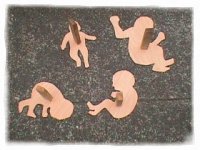 because of the information I got from her. Well… outlines of infants on the sidewalks of an abortuary will at least give you something cute to look at as you scrub them away.
In review:
1. Adam's Original Sin established all of humanity in a state of spiritual and moral destitution.
2. In the same way, Christ's obedience established all (redeemed) humanity as beneficiaries of grace and righteousness.
3. Original Sin means your problems are inside you, not in the system. You could have the perfect conditioning, and still be a fool, just because of inherited sin nature.
4. Experiencing the universal effects of Original Sin makes us mistrust others.

I just broke out some books that might help on this topic:
Jonathan Edwards, The Doctrine of Original Sin... in Works V.1

John Piper, When I don't Desire God
John Piper, The Justification of God
Hopefully, I'll get some answers from these.

Monday, December 22, 2008
The Woman's Cause is Man's
Tennyson wrote a long, epic poem called The Princess. Within it, there is a section where the prince is trying to woo the princess, after she had failed in her experiment at starting a feminist girls-only school. The prince made this speech. I came across it while I was studying for the GRE Lit. in English exam in the Norton Anthology of E. L. (major authors one-vol. edition). It represents a high-flown but well-conceived view of male-female complementarity and points out that the way to stop sexist oppression or victimization in society by either gender, is through a harmonious marriage. Marriage is where one supports the other, the other protects the one. And together, because they are different, their union makes more progress than they could on their own. This kind of lifestyle means more than feminist or chauvinist theorizing, protesting, litigating, or book-writing (although Tennyson did write a book).
'Blame not thyself too much,'I said, 'nor blame
Too much the sons of men and barbarous laws;
These were the rough ways of the world till now.
Henceforth thou hast a helper, me, that know
The woman's cause is man's: they rise or sink
Together, dwarfed or godlike, bond or free:
For she that out of Lethe scales with man
The shining steps of Nature, shares with man
His nights, his days, moves with him to one goal,
Stays all the fair young planet in her hands--
If she be small, slight-natured, miserable,
How shall men grow? but work no more alone!
Our place is much: as far as in us lies
We two will serve them both in aiding her--
Will clear away the parasitic forms
That seem to keep her up but drag her down--
Will leave her space to burgeon out of all
Within her--let her make herself her own
To give or keep, to live and learn and be
All that not harms distinctive womanhood.
For woman is not undevelopt man,
But diverse: could we make her as the man,
Sweet Love were slain: his dearest bond is this,
Not like to like, but like in difference.
Yet in the long years liker must they grow;
The man be more of woman, she of man;
He gain in sweetness and in moral height,
Nor lose the wrestling thews that throw the world;
She mental breadth, nor fail in childward care,
Nor lose the childlike in the larger mind;
Till at the last she set herself to man,
Like perfect music unto noble words;
And so these twain, upon the skirts of Time,
Sit side by side, full-summed in all their powers,
Dispensing harvest, sowing the To-be,
Self-reverent each and reverencing each,
Distinct in individualities,
But like each other even as those who love.
Then comes the statelier Eden back to men:
Then reign the world's great bridals, chaste and calm:
Then springs the crowning race of humankind.
May these things be!'
Sighing she spoke 'I fear
They will not.'
'Dear, but let us type them now
In our own lives, and this proud watchword rest
Of equal; seeing either sex alone
Is half itself, and in true marriage lies
Nor equal, nor unequal: each fulfils
Defect in each, and always thought in thought,
Purpose in purpose, will in will, they grow,
The single pure and perfect animal,
The two-celled heart beating, with one full stroke,
Life.'
And again sighing she spoke: 'A dream
That once was mind! what woman taught you this?'
'Blame not thyself too much,'I said, 'nor blame
Too much the sons of men and barbarous laws;
These were the rough ways of the world till now.
Henceforth thou hast a helper, me, that know
The woman's cause is man's: they rise or sink
Together, dwarfed or godlike, bond or free:
For she that out of Lethe scales with man
The shining steps of Nature, shares with man
His nights, his days, moves with him to one goal,
Stays all the fair young planet in her hands--
If she be small, slight-natured, miserable,
How shall men grow? but work no more alone!
Our place is much: as far as in us lies
We two will serve them both in aiding her--
Will clear away the parasitic forms
That seem to keep her up but drag her down--
Will leave her space to burgeon out of all
Within her--let her make herself her own
To give or keep, to live and learn and be
All that not harms distinctive womanhood.
For woman is not undevelopt man,
But diverse: could we make her as the man,
Sweet Love were slain: his dearest bond is this,
Not like to like, but like in difference.
Yet in the long years liker must they grow;
The man be more of woman, she of man;
He gain in sweetness and in moral height,
Nor lose the wrestling thews that throw the world;
She mental breadth, nor fail in childward care,
Nor lose the childlike in the larger mind;
Till at the last she set herself to man,
Like perfect music unto noble words;
And so these twain, upon the skirts of Time,
Sit side by side, full-summed in all their powers,
Dispensing harvest, sowing the To-be,
Self-reverent each and reverencing each,
Distinct in individualities,
But like each other even as those who love.
Then comes the statelier Eden back to men:
Then reign the world's great bridals, chaste and calm:
Then springs the crowning race of humankind.
May these things be!'
Sighing she spoke 'I fear
They will not.'
'Dear, but let us type them now
In our own lives, and this proud watchword rest
Of equal; seeing either sex alone
Is half itself, and in true marriage lies
Nor equal, nor unequal: each fulfils
Defect in each, and always thought in thought,
Purpose in purpose, will in will, they grow,
The single pure and perfect animal,
The two-celled heart beating, with one full stroke,
Life.'
And again sighing she spoke: 'A dream
That once was mind! what woman taught you this?'
Tuesday, July 15, 2008
Notes from Church campout
Here's my first post here in a long time... this Sunday my family and I went to the HoFCC church campout at Metzler park somewhere down by Molalla. It's an hour and a half drive and it was hard to sleep in the van. Anyway, Nathan Garvey preached from the story of how Absalom met his death at the hand of Joab and his men in 2 Sam. 19.
Nathan focused on the consistent pride and arrogance of both Absalom and Joab.
"Pride is rebellion against, and unbelief in, God's sovereign will.
Humility is obedience to, and trust in, God's sovereign will."
"Until we understand the effect and consequences of our pride, we'll never understand the value and significance of the cross."
Nathan focused on the consistent pride and arrogance of both Absalom and Joab.
"Pride is rebellion against, and unbelief in, God's sovereign will.
Humility is obedience to, and trust in, God's sovereign will."
"Until we understand the effect and consequences of our pride, we'll never understand the value and significance of the cross."
Tuesday, June 05, 2007
Books I've added to my library recently:
Ibsen, Henrik. Four Major Plays
Cawley, A.C. (ed.) Everyman and Medieval Miracle Plays
Willey, Basil. The Seventeenth Century Background
Albee, Ernest. A History of English Utilitarianism
O'Neill, Eugene. The Later Plays of Eugene O'Neill
Smith, Henry Nash. Virgin Land: the American West as symbol and myth
Marlow, Christopher. The Tragedy of Doctor Faustus
Bunyan, John. The Pilgrim's Progress
Latest theological reading:
John Calvin, Institutes 3.19 "Christian liberty"
Institutes 4.13 "Vows"
Martin Luther, "Introduction to Romans"
Treatise on Christian Liberty
Ibsen, Henrik. Four Major Plays
Cawley, A.C. (ed.) Everyman and Medieval Miracle Plays
Willey, Basil. The Seventeenth Century Background
Albee, Ernest. A History of English Utilitarianism
O'Neill, Eugene. The Later Plays of Eugene O'Neill
Smith, Henry Nash. Virgin Land: the American West as symbol and myth
Marlow, Christopher. The Tragedy of Doctor Faustus
Bunyan, John. The Pilgrim's Progress
Latest theological reading:
John Calvin, Institutes 3.19 "Christian liberty"
Institutes 4.13 "Vows"
Martin Luther, "Introduction to Romans"
Treatise on Christian Liberty
Tuesday, May 29, 2007
Futility
Psalm 78 has a terrible warning. Speaking of the Hebrews in the desert of Zin, it says,
32 In spite of all this, they kept on sinning;
in spite of his wonders, they did not believe.33 So he ended their days in futility
and their years in .
Futile days pass when no great purpose commands them. The years they constitute are terrifying when they are ended and nothing left but God's wrath. Save me from them. Remove the back-brace of unbelief.
Genesis 16 - Hagar
Since returning from Journey to the Heart in early April, I have had a project. The project is to scrawl out the "book of the Law" (Genesis through Deuteronomy) in composition notebooks. Today's chapter was Genesis 16, about Sarai's maidservant Hagar, whom she gave to Abram to produce a child, since God had closed up Sarai's womb.
Abram was the man who believed God's promise of a son from his own body, so that God credited his faith as righteousness, in chapter 15. He, at age 85, went along with the idea.
You might say God was showing his kindness and faithfulness to Abram's descendants (Ishmael). But it shows me that God is not a petty tribal deity in the book of Genesis. He takes note of the helpless everywhere, and -- reveals himself. Does he always? I don't know, because I only have my own experience and what's recorded in the Bible. God must somehow show his glorious attributes in everything he does, and the helpless should know that he is their shield.
He was a shield for Hagar, even though she was an Egyptian slave woman. He was a shield for Job, who lived in the land of Uz. He was worshiped by Melchizedek, king of Salem, and by Abimelech king of the Philistines at Gerar. There was nothing even special about Abram: he came from the land of the Chaldeans (Babylonians).
So does God still love the Arabs (Ishmaelites)? Yes, God still loves the Arabs.
Question 2: Why did the angel tell Hagar to go back to Sarai?
Bringing her back under authority, even a cross old lady, was part of God's mercy.
Here's the rest of the angel's message.
1 Now Sarai, Abram's wife, had borne him no children. But she had an Egyptian maidservant named Hagar; 2 so she said to Abram, "The LORD has kept me from having children. Go, sleep with my maidservant; perhaps I can build a family through her."
Abram was the man who believed God's promise of a son from his own body, so that God credited his faith as righteousness, in chapter 15. He, at age 85, went along with the idea.
Hagar got 'uppity' around Sarai, because even though her was to build a family though her son, Sarai herself would be the last of her line, supplanted by Hagar.
Abram agreed to what Sarai said. 3 So after Abram had been living in Canaan ten years, Sarai his wife took her Egyptian maidservant Hagar and gave her to her husband to be his wife. 4 He slept with Hagar, and she conceived.
So Hagar fled. I don't know what Sarai wanted (except a child), but she is ruining one thing after another.
When she knew she was pregnant, she began to despise her . 5 Then Sarai said to Abram, "You are responsible for the wrong I am suffering. I put my servant in your arms, and now that she knows she is pregnant, she despises me. May the LORD judge between you and me."6 "Your servant is in your hands," Abram said. "Do with her whatever you think best." Then Sarai mistreated Hagar; so she fled from her.
One question has been rolling around in my brain like a rock since dinner-time: Why did God have pity on Hagar?7 The angel of the LORD found Hagar near a spring in the desert; it was the spring that is beside the road to Shur. 8 And he said, "Hagar, servant of Sarai, where have you come from, and where are you going?"
"I'm running away from my Sarai," she answered.9 Then the angel of the LORD told her, "Go back to your and submit to her." 10 The angel added, "I will so increase your descendants that they will be too numerous to count."
You might say God was showing his kindness and faithfulness to Abram's descendants (Ishmael). But it shows me that God is not a petty tribal deity in the book of Genesis. He takes note of the helpless everywhere, and -- reveals himself. Does he always? I don't know, because I only have my own experience and what's recorded in the Bible. God must somehow show his glorious attributes in everything he does, and the helpless should know that he is their shield.
He was a shield for Hagar, even though she was an Egyptian slave woman. He was a shield for Job, who lived in the land of Uz. He was worshiped by Melchizedek, king of Salem, and by Abimelech king of the Philistines at Gerar. There was nothing even special about Abram: he came from the land of the Chaldeans (Babylonians).
So does God still love the Arabs (Ishmaelites)? Yes, God still loves the Arabs.
Question 2: Why did the angel tell Hagar to go back to Sarai?
Bringing her back under authority, even a cross old lady, was part of God's mercy.
Here's the rest of the angel's message.
11 The angel of the LORD also said to her:
"You are now with child
and you will have a son.
You shall name him Ishmael, [a]
for the LORD has heard of your misery.12 He will be a wild donkey of a man;
his hand will be against everyone
and everyone's hand against him,
and he will live in hostility
toward [b] all his brothers."
I don't get what's so desirable about being a wild donkey. Maybe it ensures that, like Esau, you won't stay under anyone's domination. (By the way, Ishmael means 'God hears'.)
13 She gave this name to the LORD who spoke to her: "You are the God who sees me," for she said, "I have now seen [c] the One who sees me." 14 That is why the well was called Beer Lahai Roi [d] ; it is still there, between Kadesh and Bered.
P.S.
15 So Hagar bore Abram a son, and Abram gave the name Ishmael to the son she had borne. 16 Abram was eighty-six years old when Hagar bore him Ishmael.
Saturday, December 09, 2006
Constant love needs an eternal end
Nehemiah 9:32-33
"Now therefore, O our God, the great, mighty and awesome God, who keeps his covenant of love, do not let all this hardship seem trifling in your eyes--the hardship that has come upon us, upon our kings and leaders, upon our priests and prophets, upon our fathers and all your people, from the days of the kings of Assyria until today. In all that has happened to us, you have been just; you have acted faithfully, while we did wrong."
Eliz. Barret Browning, Sonnets from the Portuguese XIV
If thou must love me, let it be for nought Except for love's sake only. Do not say I love her for her smile--her look--her way Of speaking gently,--for a trick of thought That falls in well with mine, and certes brought A sense of ease on such a day -- For these things in themselves, Belovèd, may Be changed, or change for thee,--and love, so wrought, May be unwrought so. Neither love me for Thine own dear pity's wiping my cheek dry,-- A creature might forget to weep, who bore Thy comfort long, and lose thy love thereby! But love me for love's sake, that evermore Thou may'st love on, through love's eternity.
"Now therefore, O our God, the great, mighty and awesome God, who keeps his covenant of love, do not let all this hardship seem trifling in your eyes--the hardship that has come upon us, upon our kings and leaders, upon our priests and prophets, upon our fathers and all your people, from the days of the kings of Assyria until today. In all that has happened to us, you have been just; you have acted faithfully, while we did wrong."
Eliz. Barret Browning, Sonnets from the Portuguese XIV
We love because He first loved us
Elizabeth Barret Browning, Sonnets from the Portuguese XII
Indeed this very love which is my boast, And which, when rising up from breast to brow, Doth crown me with ruby large enow To draw men's eyes and prove the inner cost,-- This love even, all my worth, to the uttermost, I should not love withal, unless that thou Hadst set me an example, shown me how, When first thine earnest eyes with mine were crossed, And love called love. And thus, I cannot speak Of love even, as good thing of my own: Thy soul hath sn@tched up mine all faint and weak, And placed it by thee on a golden throne,-- And that I love (O soul, we must be meek--) Is by thee only, whom I love alone.
Tuesday, November 21, 2006
Copper price graphs


Graphics:
From London Metals Exchange website, http://www.lme.co.uk/dataprices_pricegraphs.asp
Price graph with values: copper, Jan. 1 2001-Nov. 21 2006, 3 months buyer contract.
Price graph with values: copper, Jan. 1-Nov. 21 2006, 3 months buyer contract.
Copper 3-months buyer contracts on LME
Monday, August 07, 2006
Current reading

Right now I'm reading:
Reclaiming Surrendered Ground by Jim Logan
The New Testament (last read 1 Thess.)
Subscribe to:
Posts (Atom)
